Friday, 18 April 2014

Exercise - Photographic book covers - choosing imagery

Photography as a book cover can be of any genre. For this exercise we are asked to find some examples in the following categories.

  • Out of Focus
  • Inverted
  • Historical archival but not depicting the subject
  • Still life close up
  • Minimalist landscape or scene for large sky

Within each type I will discuss the suitability of the cover after some research into the contents of the book and offer a conclusion why the publishers chose the image.

Out of Focus


"Disguise" is a tale of illegal wartime adoption and the subsequent life story of a man (Gregor) who spends his life with a suspicion that he may not be who he thinks he is. His adoptive parents and his real mother engage in lies and deceit to conceal the reality of who he is. The strain eventually takes it toll and Gregor leaves his wife and family to become a musician and tours Canada and Ireland, "an entire lifetime of departures and comebacks". Described as " a story of double misfortune turned into multiple good luck". 
The publishers will have wanted to convey the uncertainty of the central character and the lack of authenticity in the life of Gregor. The blurred image over written with the title word "DISGUISE" is sufficiently connected to offer a hint of a character who is not known and deliberately hidden.

Inverted


"NoVA" is set in North Vaginia, an otherwise normal part of the suburbs of Washington DC. It as view of contemporary America that starts with a 17 yo boy hanging himself and the subsequent ramifications that surround his family and friends. A tale of sex and drugs amongst the middle classes who work for the technology companies, federal contractors and government institutions of this area. Sharp social observation and dark humour are amongst the techniques used by Boice in this disturbing tale. The cover is not an obvious choice and the inverted picture can only be a metaphor for the upside down world inhabited by the characters. The white painted fence being typical in a clichéd sense for the middle class gardens surrounds of the eastern USA.
Historical


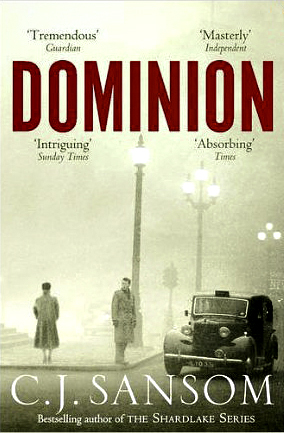
"Dominion" is complete fiction with a story that we have all pondered on at some stage. What If we hadn't won the second world war and the Nazis had control of Great Britain. Sansom creates a totally believable place where Jews live in fear, the radio and television are under state control and an underground Resistance movement is led by an ageing Winston Churchill. A Resistance spy is caught up in a plot to free a civil servant who has a secret that could change the world.
The publishers have chosen a cover photograph that is correct for the post war period. The foggy scene is perhaps London (although that's not crucial) and has a touch of menace with isolated characters exchanging a glance while a black cab is close by. 

Still life

De Botton takes the reader through 10 self contained studies of the sorrows and pleasures of the complex "workplace". These range from a biscuit factory in Belgium to the soulless headquarters of a firm of London accountants. It is a work of psychology and ideology rather than a practical guide to survival in the workplace. The book teems with interesting detail and shrewd commentary but there is no linear argument. A book rather more for discussion than a "how to". The cover chosen for the edition above shows an office chair in it component parts. We don't know whether it is new and waiting to be assembled or whether it has been taken apart. It shows us the parts rather than the sum of the parts and that is how the book is arranged. As I mentioned, there is no linear argument, only a series of disconnected studies. The photograph connects on a materialistic level, in as much as we are all familiar with a chair in the office an we recognize it here.

Minimalist landscape


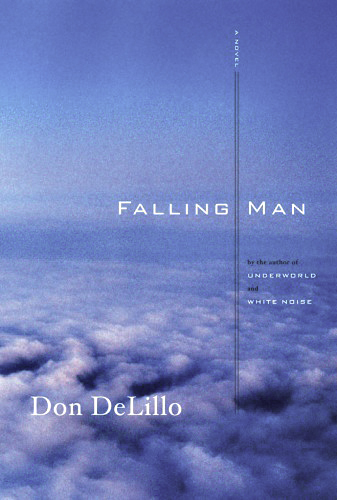
A story emanating from the attacks on the Twin Towers of The World Trade Centre in New York on September 11 2001. Keith the central character is caught up in the periphery of the event and finds himself making his way to his one time family home where he is reunited with his estranged wife. He recounts to her seeing people falling from the windows of the twin towers and then later they watch a performance artist recreate the scene as a stunt. Keith feels his life is falling away and through various minor story variations the theme develops to incorporate all three.

Apart from the text on this cover there is nothing other than clouds and two vertical parallel lines. It is clear why the photograph has been selected. The "Falling" theme is present physically and metaphorically throughout the book and the shot from above the clouds invokes a feeling of vertigo, height and danger. The two parallel lines act as a metaphor for the falling action, or at least a trace of it where it has been.


Conclusion

I am concious that there are two ways of approaching this subject at the conceptualisation stage of the process. The straight forward concept will use an image that is overtly connected with the content of the book. The other option is to use an image that is symbolic or at some secondary level has an allegorical link to the content. The use of metaphor is perhaps the most often used to entice the reader to take a closer look inside. There is a point at which the imagery will become too obscure and that can only be counter productive. The typology has to fit around the image and as such is in a auxiliary role. A cover design using graphic art techniques would start with the text and manipulate a design to suit. 

Wednesday, 9 April 2014

Something and Nothing

I find it difficult these days to come to terms with how banality has taken over my life. Personal circumstances can change so quickly and we have to follow a path through life sometimes not of our own making. I wont go into the detail of what happened a year ago but family matters took over and now as a carer the days are different as my world condenses into a semi medical/domestic routine. A trip to the supermarket for an hour being taken as a rest and the chance to see the world. This lifestyle has had an impact on my photography. No longer can I come and go as I please to places I view as interesting or inspirational. Initially I saw these restrictions as the end of my photography and for a while there was a low point with no activity and when I did force myself to make some images (Assignment One) they were not perhaps my best and I reverted to type and made work reminiscent of the past and inside my comfort zone.

Life has now settled down, I dont find the daily chores so daunting and unattainable anymore and photography is once again making its way back into my life. Assignment Two has been sent off to my tutor and between us we have agreed upon a way forward for Three which is very encouraging.

Something or Nothing is the title of chapter 4 in Charlotte Cotton's book "the photograph as contemporary art" and is one of my favourite long term reads. In this chapter she looks at and explains how non human things that are often seen as being ordinary can be made extraordinary when being photographed. There is nothing extraordinary about our house or the garden so by definition everything is ordinary and is my world photographically for the foreseeable future. As Cotton reminds us we pass by the ordinary or keep them at the periphery of our vision and automatically give them no credence within visual art.

For Assignment Three I intend to make a set of images of the generally non photographed items from my close everyday life captured simply with little post production. The brief will be to capture the banal and foster a curiosity in the item by leaving out some of the visual clues and inducing contemplation with the simple.

Maybe on these lines

Or this.


Friday, 28 March 2014

Off on a Tangent

I am finding it difficult to concentrate on the exercises at the moment. I know the reasons but only time will change my attitude towards them, so in the meantime I am happy to sit and take a few Springtime bird shots. On issues of layout and placing the images on a page I am still trying to determine the need for a white border for colour photographs. Maybe these two will help me see the issues and gain an outcome.


Goldfinch - D800 with 500 f4 and 1.4TC

Greenfinch - D800 500 f4 with 1.4TC
 
Robin - D800 500 f4
 

Saturday, 15 March 2014

Using Type Tools - Applying a drop shadow to type

Following on from the previous exercise and using the same file the task now is to add a drop shadow to the title text. This was not a technique that I had come across before.

The workflow is.


  1. Duplicate the "Title" layer
  2. Click on the lower of the two
  3. Layers > Gaussian Blur and set radius to 10 pixels
  4. Use Move tool
  5. Move down and to the right
  6. Layers window, set opacity to 50%


Screen grab with drop shadow.

The technique is a gimmick and not one that I will be using too often. There are numerous variations within the capabilities of Photoshop to produce work suitable for any number of situations.


Screen grab for coloured drop shadow


More to be added.


Using Type Tools - Getting Started

This section of the course will demonstrate the text tools in Photoshop in readiness for the book cover assignment.The title Getting Started is a course annotation and not mine. In my work I have been using the text features within Photoshop for 10 years. It will be by way of a refresher then to do the exercises and by further probing I am sure I will find something new.


As a start, a simple piece of text and a title, using Verdan 48 pt for the title and Ariel Regular 12 pt for the main text. The text is left aligned with the grid and a vertical guide used in the page centre line.


Saturday, 22 February 2014

Exercises Part One - Reflective Thoughts.

Writing about Photography.

Photography is a visual medium and as photographers we express ourselves with the images we make. The thought processes during this work, before we shoot, during the shoot and later in post production can be from the most simplistic to the most profound but generally stay within the subconscious. Having chosen the camera over the typewriter a decision was made to suit our abilities and aspirations. When we look at the photographs made by others we ask ourselves questions and build to a position where we gain something from the experience. Putting that response into words in an orderly fashion is the crux of this first section. The initial work of captions is often the stating of the obvious and has to be achieved within set guidelines, depending upon the audience. Writing about photography and photographs is always going to have an element of subjectivity although a structure is necessary and the audience's potential knowledge of the subject needs to be taken into account. Writing academically has a more structured approach with guidelines on research and writing style and I have found the research carried out so far to be interesting and inspiring. A trait however is to go off at a tangent and read outside of my immediate needs and as a result get behind with the prescribed work. This was particularly so with the analysis of London Street 1951, Robert Frank. Frank was a name I knew but until this research I had not realised the genius of his work and I am spending more of my time with London/Wales and the ITV The South Bank Show film made prior to his 2004 exhibition at Tate Modern.

As an introductory essay Understanding a Photograph, John Berger was not the easiest piece to get to grips with. I knew nothing of Berger at the outset and found the various films on YouTube (particularly his TV series Ways of Seeing) a useful introduction into the world of this curious (fascinating) man. He is better know in literary circles as an author, art critic and poet. His analysis and critique of various photographic work is contained in a relatively new book Understanding the Photograph, 2013. At first I was quite hostile towards him and I think most photographers faced with a non photographer offering such controversial opinions feel the same. Thereafter I began to mellow and surprisingly enough I now find myself agreeing with much of what he says. Time (his essay was written in 1972) has proven him wrong on a few issues but generally speaking his consensus that photography is not fine art will always bear a degree of truth.

To be able to write and analyse photographs and essays on photography is not easy. I have read many texts on how to achieve this and there is one underlying "must have" and that is the time spent on research. The British Journal of Photography and Source magazine are an excellent resource of essays on contemporary photography and I spend more time now reading these and following up introductions they make to new photographers. The single most overwhelming issue I have to overcome when writing about (or just thinking about) photography is to put aside any preconceived ideas and opinions that I may have which are personal and without a cogent argument. I then need to make sure my research is carried out sympathetically and carefully, without bias and detailed enough for the work in progress.

It is difficult to know to what extent any of this is having on my own photography. I take fewer "pretty" pictures and spend time on work based on abstract ideas, much of which never sees the light of day. The act of writing about photography is adding to my subconscious reaction to photographs and photography and it would be wrong to say that I work differently due to a single learning moment but I have changed as a photographer during this (level 2) process.


Friday, 21 February 2014

Exercise - Analyse an Essay

Understanding a Photograph, 1972 - John Berger

After my initial reading of this essay I decided there was a need to understand more about John Berger and who was influencing him. In the introduction to the book Understanding a Photograph, 2013 the editor Geoff Dyer explains that Berger is heavily influenced by Sontag's  On Photography and how Barthes is"the only living critic and theorist of literature and language whom I, as a writer, recognises". All three had been influenced by Walter Benjamin's A Small History of Photography, 1931.

An essay written in 1972 and influenced by such eminent writers and theorists as Sontag, Barthes and Benjamin will to some extent be out of date in 2014 when compared to contemporary thinking and practices, especially around the work of museums and their curators.

Analyse the various paragraphs, in one sentence.

1.Photography, in the view of most people is not Fine Art and those that argue otherwise do so academically.

2.Few museums have space for photography and therefore only a small number of photographs are preserved in isolation away from the public.

3.Art (Painting, Sculpture) cannot survive and not become valuable as property, whereby it gives protection to the owner.

4.Photographs cannot be art as they have no rarity, they are not unique and as they are not valuable as property they cannot be considered.

5.Photography is a record of what the photographer wants to record and is a human choice.

6.The photograph has a message and the photographer's decisions during its making render it memorable or banal.

7.Composition when considered in photography is different to composition in painting and fine art because painting is an art of arrangement.

8.A photograph relies upon the viewer to have some knowledge and understand its meaning.

9.The photographers only choice is to photograph when not what, thus determining absence versus presence.

10.Photography is a moment in time, recorded in isolation while a painting is made over time and has a different language.

11.A photograph is an image of isolation, recording a moment and is valuable for what is not shown as for what is.

12. There is value in a photograph if it portrays truth, a decision however that remains with the viewer.

13. The message within a photograph may be more complex than first attributed.

14. Photography, due to its truth is powerful when used as a weapon.

What is Berger's Argument ?

He is arguing that photography is not fine art because as an object it is not unique. He believes it to be a means of recording a moment in time and as such is devoid of artistic arrangement.

John Berger is well known for his socio-political stance. How is this reflected in the argument that he presents in this essay ?

Berger is an artist, author, art critic, poet and self confessed Marxist. He argues quite strongly that photography is not art but as a weapon in an ideological struggle that can be used for and against us. In 1972 he wrote that photography was not in museums and therefore had not been preserved in isolation away from the masses. If photography were to held in museums it would be hidden. This is not correct and in 2014 photography is in museums and being seen and witnessed by the masses.

Are you convinced by Berger's Argument ?

As an ideological piece of work there is much of Berger that is still relevant despite the 40 or so years that have passed. The world of museums and their curators have moved away from his thinking and most collect and display photography as fine art although the commercial gallery is more often interested in the value of the work rather than its artistic integrity. As a photographer I do not feel violated when photography is not seen as art, so in that respect I agree with Berger and I abstain from the argument when amongst artist from the more established disciplines. Its lack of uniqueness and rarity is an overwhelming argument one would think. However the value of sales of photographs has risen into six figure sums which displays an appetite amongst collectors for this medium.

What is your opinion of Berger's writing style ?

Berger writes in an academic style and that initially made it difficult to understand. I was often wondering if there were just too many words but after reading this essay and others in Understanding a Photograph 2013 I begin to understand his argument not only at a superficial level (the words) but within the words there is more of Berger. From an initial skepticism I am prepared to read more from this highly respected artist and writer.