Sometimes it is difficult to know whether the tutor was taken by an assignment or not. I tend to look at the negative parts of the report and dwell on them too much rather than find the positives and be pleased with the outcome. In this instance it was difficult for the tutor as I had gone away from the prescribed requirements of the assignment and built my own. The reasons for this are that I am unable to spend long periods away from home (anything above one and a half hours) due to Carer responsibilities. The work I had made was to look in detail at The Botanical Motif in Fine Art Photography using the title "Beyond Beauty". This was presented as an essay accompanied by 15 photographs.
The prints were well received and commented on as technically very good although a few were described as having lost detail due to heavy printing. I know what this comment refers to and I wish I had made more of an explanation in the technical part of the text to authenticate this. I tend to not write too much on the technical these days as it has in the past been seen as unnesecary, although I wish I had here. Karl Blossfeldt's early work was not technically that well accomplished and he did produce work with a lack of mid tones. I could find no explanation of this, instead coming to my own conclusion that the orthochromatic film he used (panchromatic had not been invented, although he did use it later) with its limited range of the spectrum did not work well with the green colour in the specimens he was photographing. The photographs were being made as an aid to drawing students in a classroom and Blossfeldts main focus was on the shape and form, not as a photograph with the technical baggage that we bring in a contemporary print with its near perfect tonal range. So, the intentional lack of mid tones to simulate this is seen as an error which is disappointing. I will rectify this for assessment with a better technical explanation of the Blossfeldt process rather than making full tone prints. I have in recent assignments been conscious of presenting too much technical information of the work, especially the post processing as this was previously looked upon as not necessary and that more effort should be focused on the conceptual thinking. My role here is to acquire the correct balance.
The prints and the text had covered the botanical motif from Fox Talbot through to Warhol and the contemporary work of Amanda Means. The tutor thought that this was a step too far as it had brought colour images in onto the end of what was primarily a monochrome submission. I agree with this comment and had felt uneasy when including the Warhol inspired images at the time. I know not to mix colour and monochrome but on the other hand I wanted to tell the whole story of the botanical motif. In hindsight and for the assessment version I will limit the work to Fox Talbot and Blossfeldt.
Beyond the prints (one of which will be reprinted and entered into the 46th Eastern Open) I am asked to make a mock up of pages in a Fine Art magazine and produce the assignment as a feature on Karl Blossfeldt.
A comment that crops up from time to time from my tutor is that there needs to be more of ME in the work. It came through in assignment 3 but was not to evident here perhaps. I completely understand the comment and need to do more to correct it. I am having to devise a way of modifying my conceptual thinking to take into account the current constraints in how I can work. My desire to do work inspired by New Topographics will have to wait and I have to think of work that can be constructed in the studio. To that end I have to be careful not to think studio first, but last. The ideas need to come first and a suggestion of thinking in metaphors may be the route I am taking. Less of the Real and more of the Simulated. Back to Postmodernism and leave my Modernist tendencies behind. I would also like to be more experimental but am sure it would fail, which in itself is failure I guess at being a bit too middle of the road. A recent forum debate led a tutor to suggest the students should be nearer to failure and maybe sometimes fail on the journey to success. Bold thinking indeed but at £1000 a module and over a year of your life in the making it would be extremely bold to go too close to that suggestion. In the times when the State paid for the HE that certainly allowed the more adventurous that opportunity. So before this posting evolves into a rambling rant I will conclude, sound in the knowledge that I could do better.
Showing posts with label Assignment 5. Show all posts
Showing posts with label Assignment 5. Show all posts
Saturday, 1 August 2015

Tuesday, 2 June 2015
Assignment 5 - Introducing Andy Warhol
My research of the botanical motif started with Fox Talbot, moved to Blossfeldt and has ended in the Post Modern with Andy Warhol. It is difficult to know where to begin and end with this type of image. The original is a distant memory made a few weeks ago now reincarnated into something completely different than maybe Blossfeldt would have envisaged. I am not sure how much of this work will get into this assignment or get to assessment because I am somewhat coy about the amount of post processing that goes into these.


Black Background

White Background
White background added.
Wednesday, 27 May 2015
Assignment 5 - near completion and some closing thoughts.
While I write these few thoughts the printer is busy in the background making the last of the prints ready to send off to my tutor. There is more text to write. The text is in the muddle stage at the moment, with a number of paragraphs on a specific issue or subject associated with the assignment, but no real Introduction, middle and Conclusion. I assume, and only the next few days will confirm this that the muddle will become a coherent six to eight pages of mini essay. I am hoping that when all the prints are in front of me I will be able to comprehend what it is I am doing. This may seem strange, of course I know but seeing the work as a cogent piece of work may have the answer to some of the problems of bringing the work into context, rather than it just being an interesting exercise. I know from previous work that the technical difficulty is of little consequence so I am limiting my writing on that aspect to a few words. The wider context has developed as the images were made and the research continued. The initial thrust was with Karl Blossfeldt but I have widened that now to include William Henry Fox Talbot, Anna Atkins and Julia Margaret Cameron with contemporary references to Amanda Means, Stephen Gill and Rachel Warne.
It is clear that botanical photography sits in two distinctly separate genre. The botanist is interested in the specimen and its place in a catalogue complete with Latin name and common name. The artist is exploring found objects within nature, isolating them or using them in the abstract. I feel a slight unease that I don't know the names of the specimens but I gain some comfort that by not naming them I am not exposing myself when I incorrectly identify them. This would seem a worse situation than no name at all.
For the assignment however I need to identify them, so maybe a simple numbering system will do or do I invent non botanical titles? I 'me not sure.
I need to consider the Learning Outcome. On the face of it I set out to recreate some 100 year old images in a 21st century studio. It has turned out to be a much wider piece of work. The research into Blossfeldt was difficult online (it seemed everyone had read Wikipedia and moved a few words around and published) but broadened into a detailed biographical review with the aid of three of his books. This in turn led to a wider look at botanical photography which goes back to the heart of photography and Fox Talbot. This is the first time I have set up a professional studio for macro work and now that I have overcome a number of engineering and technical issues there is scope to develop this for future work. Still life and the Dutch old masters I don't think so, but I have a few ideas for abstract based images that can be made here.
The assignment has at its base a job of work, which is to produce art that is commercial. This will not happen till later when I try and sell some and enter the 46th Eastern Open in October.
It is clear that botanical photography sits in two distinctly separate genre. The botanist is interested in the specimen and its place in a catalogue complete with Latin name and common name. The artist is exploring found objects within nature, isolating them or using them in the abstract. I feel a slight unease that I don't know the names of the specimens but I gain some comfort that by not naming them I am not exposing myself when I incorrectly identify them. This would seem a worse situation than no name at all.
For the assignment however I need to identify them, so maybe a simple numbering system will do or do I invent non botanical titles? I 'me not sure.
I need to consider the Learning Outcome. On the face of it I set out to recreate some 100 year old images in a 21st century studio. It has turned out to be a much wider piece of work. The research into Blossfeldt was difficult online (it seemed everyone had read Wikipedia and moved a few words around and published) but broadened into a detailed biographical review with the aid of three of his books. This in turn led to a wider look at botanical photography which goes back to the heart of photography and Fox Talbot. This is the first time I have set up a professional studio for macro work and now that I have overcome a number of engineering and technical issues there is scope to develop this for future work. Still life and the Dutch old masters I don't think so, but I have a few ideas for abstract based images that can be made here.
The assignment has at its base a job of work, which is to produce art that is commercial. This will not happen till later when I try and sell some and enter the 46th Eastern Open in October.
Monday, 18 May 2015
Assignment 5 - Blossfeldt - Postmodern
During some PP time I am exploring how Blossfeldt would have worked in the digital Postmodern age, 100 years on from his seminal work.
I am sure colour would have played an active part in this but to what extent. The image below is taken to an extreme graphic element rather than a photograph but who is to say he wouldn't have made this type of work.

I am sure colour would have played an active part in this but to what extent. The image below is taken to an extreme graphic element rather than a photograph but who is to say he wouldn't have made this type of work.

Sunday, 26 April 2015
Assignment 5 - Blossfeldt
It has become a challenge to understand where I am going with this assignment. The Blossfeldt images that I am looking at are mesmerising with an undercurrent of suspicion that I am using the wrong reasons for studying them. Given the time I can spend on this, which is limited, I will not be able to present any of my work as "botanical" due to a lack of botanical knowledge. Blossfeldt was a botanist and his work was correctly catalogued and titled with the common name and the Latin name for all his specimens. The purpose of this assignment in any case is not to mimic Blossfeldt but create a new set of images, prepared using contemporary techniques that convey the same qualities as the original work. I will make a few images that look like Blossfeldt originals so that I can compare them with my newer work and question if he would have made similar work had he lived 100 years later.
Examples below from an ever progressing studio full of leaves and twigs


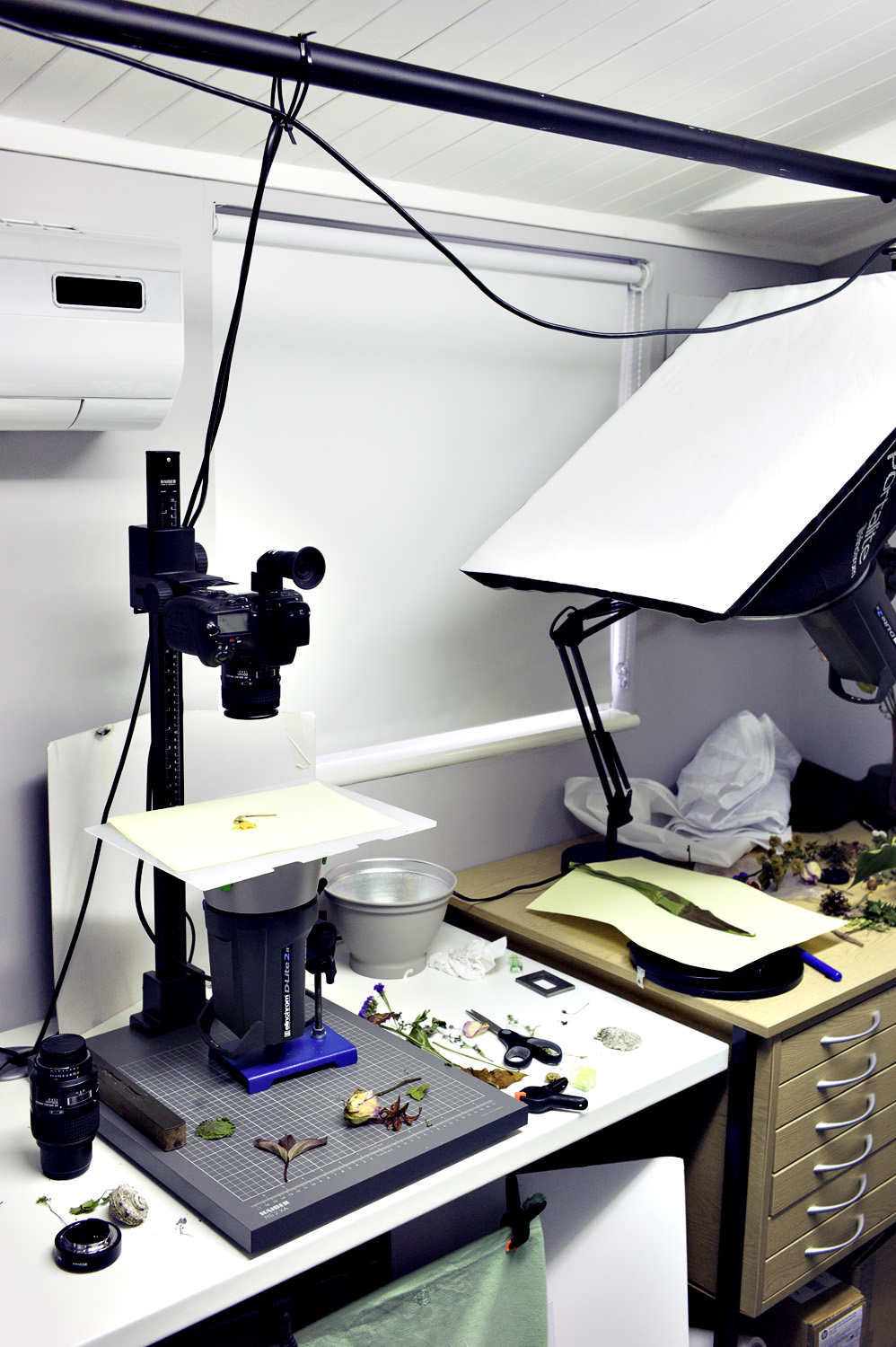
 The studio has to have a different set up for the vertical shooting. In my contemporary Blossfeldt I am back lighting the subject with a studio flash. The attempt at using a light box failed due to lack of power. This has been overcome by using a D Lite fixed to the retort stand and layers of yellow paper laid onto a Perspex sheet just above the light. The light is set to minimum power and the number of layers of paper act as a neutral density filter when achieving correct exposure. The yellow paper when converted to monochrome is providing the correct texture and it allows enough light through to back light the subject and define the veins and structure of the leaves and petals. This is of course the primary purpose of the exercise, the discovery of the designs of nature. A top light is needed to stop the image becoming totally silhouetted. A D Lite with soft box is aimed at the white ceiling to achieve this. The camera is now fitted with a 90 degree finder/magnifier to allow the accurate focusing required. The initial tests are being carried out using f40. This is not ideal as the lenses (60mm and 105mm) may be slightly soft at this small aperture. I will consider later whether I need to do focus stacking where I can then reduce the f stop to maybe 11 and still achieve a good depth of field.
The back lighting is producing a nasty outline to some images. This is being treated with a small amount of Gaussian blur applied with a very small soft brush in CS5. Initially I was concerned about retouching, especially the images that are to serve as authentic Blossfeldt. During further research however it is come to light that Blossfeldt was the master at retouching. As he was using 6cm x 17cm glass plates he had plenty of area for painting the negative and examples are shown in Karl Blossfeldt 1865 - 1932, Hans Christian Adam, Taschen.
The two photographs below show the studio set up for vertical shooting.


Examples below from an ever progressing studio full of leaves and twigs
In the style of Blossfeldt
Contemporary Blossfeldt
Post Modern Blossfeldt
Experimental Blossfeldt
Alternative vertical shooting technique.
The back lighting is producing a nasty outline to some images. This is being treated with a small amount of Gaussian blur applied with a very small soft brush in CS5. Initially I was concerned about retouching, especially the images that are to serve as authentic Blossfeldt. During further research however it is come to light that Blossfeldt was the master at retouching. As he was using 6cm x 17cm glass plates he had plenty of area for painting the negative and examples are shown in Karl Blossfeldt 1865 - 1932, Hans Christian Adam, Taschen.
The two photographs below show the studio set up for vertical shooting.

Monday, 30 March 2015
Assignment 5
After consultation with my tutor we have agreed upon the scope of assignment Five.
The assignment will centre around the work of Karl Blossfeldt. I will write a short essay as a background to his life and work and that will be followed by a small body of work along similar lines to his. The final outcome will be to enter some of the work in suitable juried exhibitions and gain exposure of the medium of macro botanical work in the local Press.
I have been carrying out some exploratory work, especially the setting up of a macro studio and collecting specimens. Specimens are hard to come by outdoors at this time of year so I may have to postpone this a few weeks. In the meantime the essay research can take place. Little exists about Blossfeldt outside of his books and they are in short supply new. I have managed to acquire a good second hand copy of Karl Blossfeldt 1865-1932, Edited by Hans Christian Adam - Taschen 1999.
Internet searching reveals a number of sites with biographical and technical content, but on inspection it seems that the primary source is Wikipedia, with minor changes.
There is still indecision on the technique I should use to make the images. Blossfeldt made his own camera and lenses and at the turn of the last century this was a considerable achievement, especially as he was making images with X30 magnification on a glass negative about the same size as modern medium format film. It is written that (no photographs exist) the bellows extension was in the region of 1 metre. I will not be making a camera or lens, or acquiring any further equipment for the assignment.
My options are:
1. Use a FF DSLR with either a 60mm macro or 105mm macro lens. Both of these can have extension tubes 12mm, 20mm or 36mm attached singularly or in any combination.
2. Use a 6x6 SLR with 80mm standard lens and 21mm extension tube.
The specimens can be very small, sometimes 10mm in diameter and 30mm long. The digital route will give technically better results, especially when focus stacking is employed. The purpose (as I will detail later) of Blossfeldt's photographs was so that art students could see (by projecting onto a wall) small botanical specimens in a drawing class. If Blossfeldt were given another chance of that today I am convinced he would use whatever technical advancement was available. By way of contrast and aesthetic considerations I may shoot a roll of 6x6 as a comparison.
The studio is now complete. It comprises of a 800mm x 800mm x 800mm light tent, 2 Elichrom Dlite 2 flash heads and a number of reflectors, honeycomb grids, soft boxes etc. The light rig is suspended so that the lights are above the worktop, and removes the need for light stands in a confined space. Various coloured cards are available as gobos and reflectors. A copy stand is also available if I need to shoot vertically onto flower heads on a close card background or the light box.


The assignment will centre around the work of Karl Blossfeldt. I will write a short essay as a background to his life and work and that will be followed by a small body of work along similar lines to his. The final outcome will be to enter some of the work in suitable juried exhibitions and gain exposure of the medium of macro botanical work in the local Press.
I have been carrying out some exploratory work, especially the setting up of a macro studio and collecting specimens. Specimens are hard to come by outdoors at this time of year so I may have to postpone this a few weeks. In the meantime the essay research can take place. Little exists about Blossfeldt outside of his books and they are in short supply new. I have managed to acquire a good second hand copy of Karl Blossfeldt 1865-1932, Edited by Hans Christian Adam - Taschen 1999.
Internet searching reveals a number of sites with biographical and technical content, but on inspection it seems that the primary source is Wikipedia, with minor changes.
There is still indecision on the technique I should use to make the images. Blossfeldt made his own camera and lenses and at the turn of the last century this was a considerable achievement, especially as he was making images with X30 magnification on a glass negative about the same size as modern medium format film. It is written that (no photographs exist) the bellows extension was in the region of 1 metre. I will not be making a camera or lens, or acquiring any further equipment for the assignment.
My options are:
1. Use a FF DSLR with either a 60mm macro or 105mm macro lens. Both of these can have extension tubes 12mm, 20mm or 36mm attached singularly or in any combination.
2. Use a 6x6 SLR with 80mm standard lens and 21mm extension tube.
The specimens can be very small, sometimes 10mm in diameter and 30mm long. The digital route will give technically better results, especially when focus stacking is employed. The purpose (as I will detail later) of Blossfeldt's photographs was so that art students could see (by projecting onto a wall) small botanical specimens in a drawing class. If Blossfeldt were given another chance of that today I am convinced he would use whatever technical advancement was available. By way of contrast and aesthetic considerations I may shoot a roll of 6x6 as a comparison.
The studio is now complete. It comprises of a 800mm x 800mm x 800mm light tent, 2 Elichrom Dlite 2 flash heads and a number of reflectors, honeycomb grids, soft boxes etc. The light rig is suspended so that the lights are above the worktop, and removes the need for light stands in a confined space. Various coloured cards are available as gobos and reflectors. A copy stand is also available if I need to shoot vertically onto flower heads on a close card background or the light box.
Macro set up.
Work space.
An early test to set up the lighting. There is considerable time spent with trial and error to get it anywhere near correct. The surfaces are so small and the positioning of lights, reflectors and gobos has to be millimetre perfect. Blossfeldt used window light and exposure times of 10 minutes and that soft round light is difficult to achieve.
Background colour and texture is under review. Blossfeldt used a variety, generally to suit the specimen's tones and the distance between specimen and background has an effect on the lighting set up and any texture.
More work is being carried out on this.
Apple Bud. (Early test shot)
Subscribe to:
Posts (Atom)