Pass 66%
In some respects disapointed as this is not in the First area, as Landscape was, but its still 2:1 area and if I continue to the Final Year and I continue to produce the same or better the outcome will be acceptable.
Overall comments and feedback were encouraging with the inevitable lack of my "voice" and the need to engage fully with contemporary photographic practice. The assessors liked the submission calling it "professional and accessible" with technical skills that are "advanced" and written work being "strong".
I have sought some advice from one of the senior tutors and he has been very generous with offering guidance and support for moving onto Level 3.
240 HE points in the bag, 120 more to be gained with 3 x 40 point modules and 4 years maximum to complete. BA(Hons) still seems a long way away.
Showing posts with label Reflection. Show all posts
Showing posts with label Reflection. Show all posts
Tuesday, 8 December 2015

Saturday, 22 August 2015
PWDP Completed - In a reflective mood.
In a few days time the 2 year time limit indicates the end of this module. I did not intend it to take so long but personal issues a while back meant delays but for the past month or so I have been able to catch up and the work, especially the journal is now complete. Most of the work for assessment is also complete. The prints are finished, but need labels, the essay modifications are almost complete and awaiting some divine inspiration to know how to rewrite one paragraph that seems to elude me. The assignment write ups need printing and assembly into their folders and the electronic files will be collated when a new USB stick arrives. I assume during the run up to November assessment (sometime in early September) the labels will come from OCA to stick on the box. The box will be delivered by hand to OCA as I cannot risk it being lost or damaged.
Aside from the completion of the submission it is time to sit and think and reflect on the module and look forward to what happens next. Progressing with Digital Photography is not the correct title for this module. Why the word digital is in there I do not know. Progressing with Photography is more suitable, but that could apply to any course after one called Starting with Photography. It assumes everyone is using digital practice and that might not be the case, and while most of us are (or a hybrid practice) there is nothing in the assignments that forces you to develop any advanced digital techniques. I am sure that is not the intention anyway as on its own being good at Photoshop or whatever is unlikely to make your work any more progressive than those with basic skills. The increase in skills really depends on where you are starting from anyway, but I am pleased with the one or two new areas of expertise I have learnt, especially through the book cover assignment where my layout skills, text and use of multiple layers has been useful since.
Being able to make a drop shadow on text in Photoshop may seem to some to be useful and, yes I did it so as to tick the box, but was that really necessary.
At a different level, the module has through the support of my tutor helped me to develop more narrative and be less of an object based photographer and see more in the implied. I have learnt to not be afraid of ambiguity and realise that I do not have to take an idea to the viewer with an explanation of what I am thinking or doing. Less is more and while the images have to be relevant they do not have to be illustrations. Art photography is not an instruction manual for the viewer to be told what to think, it is a platform for semiotics and signs. This requires the photographer to be aware and conscious of the context of where the work is to be seen and then adjust the message through text and the selection of images. We need to be aware that not all of our work is viewed by keen academic arty types, but there are others who need to be drawn in to the work and not made to feel as though the art world is alien to them.
I will have to wait for the November results before I decide where I go next. The natural progression is to Level 3 and the degree, but that may not be where I need to be. I have not discussed the Level 3 syllabus with anyone yet and that discussion will be key to the way forward. I started the degree pathway because as a practising semi freelance photographer I wanted to learn more and become aware of different ways of thinking and making art. The course has shown me how to do this, by introducing me to the various artists, photographers, writers and philosophers who have made a difference and influenced contemporary photographic art. With those introductions I can continue to read and study, maybe even write, and certainly make more photographs. I take a great interest in the work of other students, read about their work and study their approach to practice and theory. I have found it worthwhile to take part in the online forum by helping others when I can and posing questions to them when I have been stuck.
I understand that this degree course is, by its title "Photography" a wide brief, and we have to teach ourselves. There will be no lectures and there are no facilities, but on the other hand there are no high fees. This doesn't bother me though as I don't need a photography degree to get a job, but I wonder how suitable it would be if I did. As OCA students we get no time in a professional studio environment and many have no access to high quality post processing and printing facilities. This tends to make the course content less focused on photography practice than maybe it would elsewhere. Since I joined OCA there is a tendency to now include more critical theory and visual culture studies. I seem to remember a comment some time ago that OCA had to include more because up until then the content wasn't sufficient and "we were getting away with it". That may well be the situation as I have no idea what level of content others have, but my immediate thoughts were, I wonder how those you have graduated feel with that comment in the background.
Amongst the current cohort who make themselves know to each other through the forum there are certainly plenty of students who enjoy the theoretical study and do well at it. As a subject, critical theory is interesting and have myself become interested in that field especially in connection with postmodernism. I am not so sure though that I want a course that requires me to do more of that than making photographs and looking at the work of others from time to time I wonder if they too should make more photographs and become skilled at that at a higher level. The study of critical theory can and does influence practice, it requires us to think and place our work in context but that work has to be able to be shown in a professional environment and that part of the craft of making fine craft (not art) photography is not championed by the OCA. This in some part is of course down to the student to make the work, know what it should look like (by having seen first class work at exhibitions etc) and then find out how to make similar work. The level 3 modules seem to have split the theoretical studies away from the body of work in two work streams so I hope that allows for plenty of photography in at least one.
Photography is my life, I spend every waking hour thinking about it in some context or another. Whether it is to buy a new lens, a new book, set up something new in the studio or simple read some more from the works of the adorable Liz Wells. Dare I say I did enjoy "photography", but I don't so much now. The OCA has given me much more to think about, reasons to make images and new books to read, but, my own work, my own path is now a thing of the past. I am directed, maybe in a direction that makes me a better artist, time will tell. I want to spend more time entering juried exhibitions and that takes enormous amounts of time. Some may think it is just a quick flick through Bridge and pick something from the past and email it to the jury with the fee. Not so, it requires research and well thought through editing and then making high quality work, picking frames and mats. The time is not proportional to the rewards, but when you are selected and hung you feel something worthwhile has been achieved and an audience sees the work.
Much to think about.
Saturday, 1 August 2015
Assignment Five - Tutor Report and Reflection
Sometimes it is difficult to know whether the tutor was taken by an assignment or not. I tend to look at the negative parts of the report and dwell on them too much rather than find the positives and be pleased with the outcome. In this instance it was difficult for the tutor as I had gone away from the prescribed requirements of the assignment and built my own. The reasons for this are that I am unable to spend long periods away from home (anything above one and a half hours) due to Carer responsibilities. The work I had made was to look in detail at The Botanical Motif in Fine Art Photography using the title "Beyond Beauty". This was presented as an essay accompanied by 15 photographs.
The prints were well received and commented on as technically very good although a few were described as having lost detail due to heavy printing. I know what this comment refers to and I wish I had made more of an explanation in the technical part of the text to authenticate this. I tend to not write too much on the technical these days as it has in the past been seen as unnesecary, although I wish I had here. Karl Blossfeldt's early work was not technically that well accomplished and he did produce work with a lack of mid tones. I could find no explanation of this, instead coming to my own conclusion that the orthochromatic film he used (panchromatic had not been invented, although he did use it later) with its limited range of the spectrum did not work well with the green colour in the specimens he was photographing. The photographs were being made as an aid to drawing students in a classroom and Blossfeldts main focus was on the shape and form, not as a photograph with the technical baggage that we bring in a contemporary print with its near perfect tonal range. So, the intentional lack of mid tones to simulate this is seen as an error which is disappointing. I will rectify this for assessment with a better technical explanation of the Blossfeldt process rather than making full tone prints. I have in recent assignments been conscious of presenting too much technical information of the work, especially the post processing as this was previously looked upon as not necessary and that more effort should be focused on the conceptual thinking. My role here is to acquire the correct balance.
The prints and the text had covered the botanical motif from Fox Talbot through to Warhol and the contemporary work of Amanda Means. The tutor thought that this was a step too far as it had brought colour images in onto the end of what was primarily a monochrome submission. I agree with this comment and had felt uneasy when including the Warhol inspired images at the time. I know not to mix colour and monochrome but on the other hand I wanted to tell the whole story of the botanical motif. In hindsight and for the assessment version I will limit the work to Fox Talbot and Blossfeldt.
Beyond the prints (one of which will be reprinted and entered into the 46th Eastern Open) I am asked to make a mock up of pages in a Fine Art magazine and produce the assignment as a feature on Karl Blossfeldt.
A comment that crops up from time to time from my tutor is that there needs to be more of ME in the work. It came through in assignment 3 but was not to evident here perhaps. I completely understand the comment and need to do more to correct it. I am having to devise a way of modifying my conceptual thinking to take into account the current constraints in how I can work. My desire to do work inspired by New Topographics will have to wait and I have to think of work that can be constructed in the studio. To that end I have to be careful not to think studio first, but last. The ideas need to come first and a suggestion of thinking in metaphors may be the route I am taking. Less of the Real and more of the Simulated. Back to Postmodernism and leave my Modernist tendencies behind. I would also like to be more experimental but am sure it would fail, which in itself is failure I guess at being a bit too middle of the road. A recent forum debate led a tutor to suggest the students should be nearer to failure and maybe sometimes fail on the journey to success. Bold thinking indeed but at £1000 a module and over a year of your life in the making it would be extremely bold to go too close to that suggestion. In the times when the State paid for the HE that certainly allowed the more adventurous that opportunity. So before this posting evolves into a rambling rant I will conclude, sound in the knowledge that I could do better.
The prints were well received and commented on as technically very good although a few were described as having lost detail due to heavy printing. I know what this comment refers to and I wish I had made more of an explanation in the technical part of the text to authenticate this. I tend to not write too much on the technical these days as it has in the past been seen as unnesecary, although I wish I had here. Karl Blossfeldt's early work was not technically that well accomplished and he did produce work with a lack of mid tones. I could find no explanation of this, instead coming to my own conclusion that the orthochromatic film he used (panchromatic had not been invented, although he did use it later) with its limited range of the spectrum did not work well with the green colour in the specimens he was photographing. The photographs were being made as an aid to drawing students in a classroom and Blossfeldts main focus was on the shape and form, not as a photograph with the technical baggage that we bring in a contemporary print with its near perfect tonal range. So, the intentional lack of mid tones to simulate this is seen as an error which is disappointing. I will rectify this for assessment with a better technical explanation of the Blossfeldt process rather than making full tone prints. I have in recent assignments been conscious of presenting too much technical information of the work, especially the post processing as this was previously looked upon as not necessary and that more effort should be focused on the conceptual thinking. My role here is to acquire the correct balance.
The prints and the text had covered the botanical motif from Fox Talbot through to Warhol and the contemporary work of Amanda Means. The tutor thought that this was a step too far as it had brought colour images in onto the end of what was primarily a monochrome submission. I agree with this comment and had felt uneasy when including the Warhol inspired images at the time. I know not to mix colour and monochrome but on the other hand I wanted to tell the whole story of the botanical motif. In hindsight and for the assessment version I will limit the work to Fox Talbot and Blossfeldt.
Beyond the prints (one of which will be reprinted and entered into the 46th Eastern Open) I am asked to make a mock up of pages in a Fine Art magazine and produce the assignment as a feature on Karl Blossfeldt.
A comment that crops up from time to time from my tutor is that there needs to be more of ME in the work. It came through in assignment 3 but was not to evident here perhaps. I completely understand the comment and need to do more to correct it. I am having to devise a way of modifying my conceptual thinking to take into account the current constraints in how I can work. My desire to do work inspired by New Topographics will have to wait and I have to think of work that can be constructed in the studio. To that end I have to be careful not to think studio first, but last. The ideas need to come first and a suggestion of thinking in metaphors may be the route I am taking. Less of the Real and more of the Simulated. Back to Postmodernism and leave my Modernist tendencies behind. I would also like to be more experimental but am sure it would fail, which in itself is failure I guess at being a bit too middle of the road. A recent forum debate led a tutor to suggest the students should be nearer to failure and maybe sometimes fail on the journey to success. Bold thinking indeed but at £1000 a module and over a year of your life in the making it would be extremely bold to go too close to that suggestion. In the times when the State paid for the HE that certainly allowed the more adventurous that opportunity. So before this posting evolves into a rambling rant I will conclude, sound in the knowledge that I could do better.
Wednesday, 27 May 2015
Assignment 5 - near completion and some closing thoughts.
While I write these few thoughts the printer is busy in the background making the last of the prints ready to send off to my tutor. There is more text to write. The text is in the muddle stage at the moment, with a number of paragraphs on a specific issue or subject associated with the assignment, but no real Introduction, middle and Conclusion. I assume, and only the next few days will confirm this that the muddle will become a coherent six to eight pages of mini essay. I am hoping that when all the prints are in front of me I will be able to comprehend what it is I am doing. This may seem strange, of course I know but seeing the work as a cogent piece of work may have the answer to some of the problems of bringing the work into context, rather than it just being an interesting exercise. I know from previous work that the technical difficulty is of little consequence so I am limiting my writing on that aspect to a few words. The wider context has developed as the images were made and the research continued. The initial thrust was with Karl Blossfeldt but I have widened that now to include William Henry Fox Talbot, Anna Atkins and Julia Margaret Cameron with contemporary references to Amanda Means, Stephen Gill and Rachel Warne.
It is clear that botanical photography sits in two distinctly separate genre. The botanist is interested in the specimen and its place in a catalogue complete with Latin name and common name. The artist is exploring found objects within nature, isolating them or using them in the abstract. I feel a slight unease that I don't know the names of the specimens but I gain some comfort that by not naming them I am not exposing myself when I incorrectly identify them. This would seem a worse situation than no name at all.
For the assignment however I need to identify them, so maybe a simple numbering system will do or do I invent non botanical titles? I 'me not sure.
I need to consider the Learning Outcome. On the face of it I set out to recreate some 100 year old images in a 21st century studio. It has turned out to be a much wider piece of work. The research into Blossfeldt was difficult online (it seemed everyone had read Wikipedia and moved a few words around and published) but broadened into a detailed biographical review with the aid of three of his books. This in turn led to a wider look at botanical photography which goes back to the heart of photography and Fox Talbot. This is the first time I have set up a professional studio for macro work and now that I have overcome a number of engineering and technical issues there is scope to develop this for future work. Still life and the Dutch old masters I don't think so, but I have a few ideas for abstract based images that can be made here.
The assignment has at its base a job of work, which is to produce art that is commercial. This will not happen till later when I try and sell some and enter the 46th Eastern Open in October.
It is clear that botanical photography sits in two distinctly separate genre. The botanist is interested in the specimen and its place in a catalogue complete with Latin name and common name. The artist is exploring found objects within nature, isolating them or using them in the abstract. I feel a slight unease that I don't know the names of the specimens but I gain some comfort that by not naming them I am not exposing myself when I incorrectly identify them. This would seem a worse situation than no name at all.
For the assignment however I need to identify them, so maybe a simple numbering system will do or do I invent non botanical titles? I 'me not sure.
I need to consider the Learning Outcome. On the face of it I set out to recreate some 100 year old images in a 21st century studio. It has turned out to be a much wider piece of work. The research into Blossfeldt was difficult online (it seemed everyone had read Wikipedia and moved a few words around and published) but broadened into a detailed biographical review with the aid of three of his books. This in turn led to a wider look at botanical photography which goes back to the heart of photography and Fox Talbot. This is the first time I have set up a professional studio for macro work and now that I have overcome a number of engineering and technical issues there is scope to develop this for future work. Still life and the Dutch old masters I don't think so, but I have a few ideas for abstract based images that can be made here.
The assignment has at its base a job of work, which is to produce art that is commercial. This will not happen till later when I try and sell some and enter the 46th Eastern Open in October.
Saturday, 9 May 2015
Is it right, wrong or naive to give away a unique image ?
The Guardian has an interesting story following on from the well publicised image of a Kingfisher with a Weasel on its back. I reproduce it here as the image was given away by the photographer, Mr Martin Le-May.

Here is The Guardian story
The photograph in question was made as a result of luck. Being in the right place at the right time with the right equipment to see something that probably has only ever happened a handful of times in all of history (my guess, no way of knowing) is akin to winning the lottery. So, you have the image, you know its rare (if you don't then Google it) and then you give it away by putting it on the internet. The action of a philanthropist or that of a photographer breaking the rules. Some say the amateur photographer has wreaked havoc for the professional, especially in the world of wildlife images. The article tells the story of some of the UK's best wildlife photographers and how cheap images have impacted their lives. Or have they. Some are moving into new areas of the industry, mainly teaching on field trips to places where good photographic opportunities exist. This then is them using their field craft, an often overlooked and difficult tool in the wildlife photographers toolbox. If you know where to find a Long Eared Owl by reference to knowing their habitat preferences etc. then you wont need a guide, but if you don't then you will.
My wildlife photography will never be of much interest to anyone. I enjoy just being there and being part of the countryside to much to sit for long hours in a hide with my eye glued to the eyepiece. When I have done it and the special specimen turns up I am generally so shocked and struck by its rarity or whatever I don't get the shot. Not very professional I am afraid. The few images I have made I enjoyed making but you need more than special equipment (underwater, drones, traps etc.) today to be at the top of the tree (no pun intended). If I were to get the unique shot would I give it away?. Answer I am afraid is No. The same would occur with anything that was unique because we know how wide the market would be. I say "we" thinking of people who know anything about photography as a business.
If therefore we want to have images that cant be taken by the iPhone we need to be working on projects that exclude the millions who can. After making a list the one that stands out as the most promising is the one that is the most satisfying is Fine Art Photography. It can be achieved with the iPhone but the more esoteric work certainly cannot. Is it time for the Fine Art Photographer to batten down the hatches, learn new methods and post processing techniques and keep them hidden. If you develop a new workflow that needs 6 cameras, a laser and a ton of cement, keep it hidden. I don't suppose BMW tell Ford how they make their engines and I don't suppose Chelsea tell Manchester United how they will organise themselves before their next game of football. Maybe the internet, the all knowing blogger and You Tube have made the knowledge too widely available and the lucky along with the savvy have now caught up. Photography is no longer a artisan activity. There are no chemicals (well I know there are some but here I am looking at a general view), no darkened room, no black cloths. In fact looking back the whole process was almost witchcraft with all the perceived attachments.
Fine Art work can be commercial and if any of us want to make some money then we have to be careful. I know there would be an instant roar of disapproval if I were to write this on the OCA website. Money, Commercialisation, Commodification of art is seen as an anathema to the academic world, but that is mostly from those who have achieved status and a good income from academia rather than those at the front line of making art for a living.
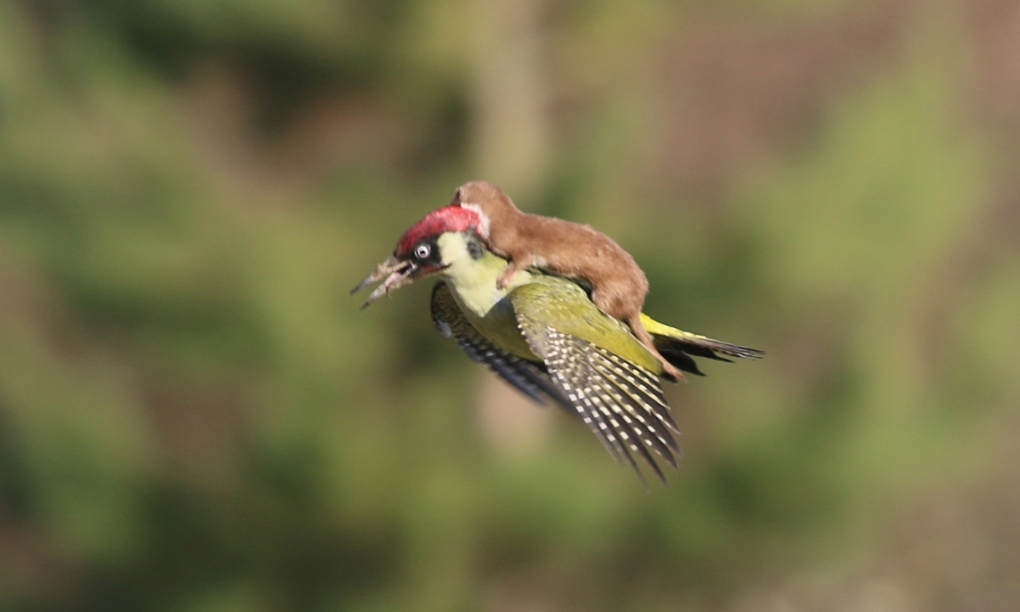
Here is The Guardian story
The photograph in question was made as a result of luck. Being in the right place at the right time with the right equipment to see something that probably has only ever happened a handful of times in all of history (my guess, no way of knowing) is akin to winning the lottery. So, you have the image, you know its rare (if you don't then Google it) and then you give it away by putting it on the internet. The action of a philanthropist or that of a photographer breaking the rules. Some say the amateur photographer has wreaked havoc for the professional, especially in the world of wildlife images. The article tells the story of some of the UK's best wildlife photographers and how cheap images have impacted their lives. Or have they. Some are moving into new areas of the industry, mainly teaching on field trips to places where good photographic opportunities exist. This then is them using their field craft, an often overlooked and difficult tool in the wildlife photographers toolbox. If you know where to find a Long Eared Owl by reference to knowing their habitat preferences etc. then you wont need a guide, but if you don't then you will.
My wildlife photography will never be of much interest to anyone. I enjoy just being there and being part of the countryside to much to sit for long hours in a hide with my eye glued to the eyepiece. When I have done it and the special specimen turns up I am generally so shocked and struck by its rarity or whatever I don't get the shot. Not very professional I am afraid. The few images I have made I enjoyed making but you need more than special equipment (underwater, drones, traps etc.) today to be at the top of the tree (no pun intended). If I were to get the unique shot would I give it away?. Answer I am afraid is No. The same would occur with anything that was unique because we know how wide the market would be. I say "we" thinking of people who know anything about photography as a business.
If therefore we want to have images that cant be taken by the iPhone we need to be working on projects that exclude the millions who can. After making a list the one that stands out as the most promising is the one that is the most satisfying is Fine Art Photography. It can be achieved with the iPhone but the more esoteric work certainly cannot. Is it time for the Fine Art Photographer to batten down the hatches, learn new methods and post processing techniques and keep them hidden. If you develop a new workflow that needs 6 cameras, a laser and a ton of cement, keep it hidden. I don't suppose BMW tell Ford how they make their engines and I don't suppose Chelsea tell Manchester United how they will organise themselves before their next game of football. Maybe the internet, the all knowing blogger and You Tube have made the knowledge too widely available and the lucky along with the savvy have now caught up. Photography is no longer a artisan activity. There are no chemicals (well I know there are some but here I am looking at a general view), no darkened room, no black cloths. In fact looking back the whole process was almost witchcraft with all the perceived attachments.
Fine Art work can be commercial and if any of us want to make some money then we have to be careful. I know there would be an instant roar of disapproval if I were to write this on the OCA website. Money, Commercialisation, Commodification of art is seen as an anathema to the academic world, but that is mostly from those who have achieved status and a good income from academia rather than those at the front line of making art for a living.
Thursday, 23 April 2015

Monday, 9 March 2015
Assignment 4 Tutor Feedback
The tutor report was accompanied by an annotated copy of the essay. The overall comments were good with some comments that require my attention before assessment (which will be in November).
The main concern was the title. As can be seen from previous postings, this was also a concern for myself. I knew what I wanted to say, but as with a lot of images, a title is not the easiest part to make.
I now see, with the help of the comments how I can change this and the new title will probably be: "How does Postmodernism impact photographic theory and practice ?" A simpler and far less cryptic version than previous. Much of the content will remain the same however. I had shown examples of Modernism and Postmodernism through the work of three photographers. This needs to be expanded upon and I will include something on The New Topographics and Mirrors and Windows: two major exhibitions of the 1970s. There was the inevitable problem of using "sweeping statements" without backing them up with sources and the praise you get for citing your own opinion. There is a fine line between the two. Upon reflection however I can see the error of my ways. Making a statement such as "It was a stark difference to the deprivation of the previous century" when describing changes from the eighteenth to nineteenth century does need to be backed up with some examples. Another example is when I have said " Artists said ..... etc" need to cite somebody as an example. The tutor suggestions on what should / could be included will have to be edited and a corresponding number of words removed from other parts of the essay. I had gone over with the word count but I am never sure if the end notes are counted or not. Also the bibliography will be included in the count but is not a part of the essay as such.
On a general note my tutor is pleased that I am visiting exhibitions and reflecting on my work. There is room for improvement in reading. This is always true but my lack of writing about what I read is at the nub of this. For this essay I guess I have read 3 books but only a handful of words get cited in the end product. With something as notoriously complex as Postmodernism there has to be background reading (that never gets cited) just so that a general level of understanding is gained, especially with a subject that is being learnt almost from scratch.
What the process has done, is given me an appetite for more, especially towards Post structuralism and a deeper understanding (maybe too ambitious) of how I am working in my practice and how concepts are formed and cemented. I was talking to a fine arts graduate a few weeks ago about her sculpture/installation work in an exhibition. We talked about postmodernism for a while and critical theory studies and I was interested in her comments that without that level of understanding she could not make any of her work. That was her base from where the work started, comments that I found very interesting and inspirational.
The main concern was the title. As can be seen from previous postings, this was also a concern for myself. I knew what I wanted to say, but as with a lot of images, a title is not the easiest part to make.
I now see, with the help of the comments how I can change this and the new title will probably be: "How does Postmodernism impact photographic theory and practice ?" A simpler and far less cryptic version than previous. Much of the content will remain the same however. I had shown examples of Modernism and Postmodernism through the work of three photographers. This needs to be expanded upon and I will include something on The New Topographics and Mirrors and Windows: two major exhibitions of the 1970s. There was the inevitable problem of using "sweeping statements" without backing them up with sources and the praise you get for citing your own opinion. There is a fine line between the two. Upon reflection however I can see the error of my ways. Making a statement such as "It was a stark difference to the deprivation of the previous century" when describing changes from the eighteenth to nineteenth century does need to be backed up with some examples. Another example is when I have said " Artists said ..... etc" need to cite somebody as an example. The tutor suggestions on what should / could be included will have to be edited and a corresponding number of words removed from other parts of the essay. I had gone over with the word count but I am never sure if the end notes are counted or not. Also the bibliography will be included in the count but is not a part of the essay as such.
On a general note my tutor is pleased that I am visiting exhibitions and reflecting on my work. There is room for improvement in reading. This is always true but my lack of writing about what I read is at the nub of this. For this essay I guess I have read 3 books but only a handful of words get cited in the end product. With something as notoriously complex as Postmodernism there has to be background reading (that never gets cited) just so that a general level of understanding is gained, especially with a subject that is being learnt almost from scratch.
What the process has done, is given me an appetite for more, especially towards Post structuralism and a deeper understanding (maybe too ambitious) of how I am working in my practice and how concepts are formed and cemented. I was talking to a fine arts graduate a few weeks ago about her sculpture/installation work in an exhibition. We talked about postmodernism for a while and critical theory studies and I was interested in her comments that without that level of understanding she could not make any of her work. That was her base from where the work started, comments that I found very interesting and inspirational.
Monday, 16 February 2015
Critical Review - Reflections
So, the critical review essay is complete and set to my tutor for feedback. On reflection I am wondering why I chose to deal with issues around Postmodernism as it has not been an easy subject. Its not that I am looking for easy in an academic sense (I like to be stretched) but any other subject may have not had so many layers, so much uncertainty when researched. There are many sources, some I consider primary such as Lyotard and his seminal work The Postmodern Condition: A Report on Knowledge 1979 and the writing of Baudrillard, Derrida and Foucault. Other books and websites are secondary providing opinion and vary considerably, even to the extent that there is disagreement on what the word means and whether it has ever occurred. My question was Is Postmodernism a Theory, Practice or Ideology?. Research threw up the disharmony so the title was set to be able to show this and it is no surprise that there is no objective answer. Prior to the research and the essay writing I had only touched upon it in small doses and was not aware of how the subject produces so much passion in those who profess to knowing the subject. If we go along with the mainstream opinion we are coming to the end of this "ism". Some say it never happened and some say it will continue, but I wonder what it means to me as a photographer. All I know (I have to be careful in saying what I know, "I think therefore I am", the worry of the simulacrum etc.) is that being contemporary with the postmodern period has me defined as a postmodernist by default. A lot of my work however does try to be "Real" in the style of Weston, Strand etc. so is "modernist" and I am not adverse to the "pictorialists" who pre-dated it. Current practice of the overtly postmodern is of little practical interest to me. I am interested in looking at it, reading it and trying to analyse what the author is telling me. On the other hand my practice is not likely to go down that route for some while.
Thursday, 15 January 2015
Emergence – King’s Lynn Arts Centre 10-17 January 2015
This exhibition highlights the talent of young artists
working locally as well as in the rest of the UK . A few of the artists have
recently graduated with BAs or MAs in Visual Arts.
The twelve artists provided twenty pieces ranging from
photography to contemporary installations using steel and wood.
From the handout it isn’t possible to determine which
artists have a BA or MA and perhaps that doesn’t matter but my reaction to the
exhibition as a whole was the range of talent from average to extraordinary and
I was curious if the MA graduates were those (in my perception) who had made
the better work.
As we are well aware the onus in a fine art exhibition (or
any fine art work) is on the viewer to read the work and find our own narrative
or gain some insight into the work from our perspective, the author having long
gone.
The works that caught my eye during a short visit are
mentioned below.
The first work by Jake Francis consisted of three items. A
chair with a head on it (titled Stoopid #2), a painting (titled Artist)and a
table with a plate, food and cutlery (titled Gloop). The content of each piece is
bizarre and set out to be controversial. The picture is of an artist palette,
but no paint, instead 3 lumps of animal (could be human) excrement. The head
was from some fruit and the food on the plate looks like a dolls dress with a a
brown fluid oozing from inside it, resembling an afterbirth with clothes on.
Jamie Kilcoin had produced 5 landscape photographs, mostly
taken around the North Norfolk coast I would
guess as I recognised some of the locations. Well produced work with lovely
image quality and presentation. As a group they have a connection in genre but
for me three in colour and two monochrome upset the rhythm of reading them as a
set.
An interesting diptych from Ivan Chambers of a female in
black leather bikini. In one she is in a church, in the other outside a Soho type theater. Various labels attached beneath the
two images. All I get here is irony and a Charlie Hebdo type of cartoon effect.
The message is not easy to read but has something to do with the fortune of
sins. Not easy but well delivered.
Jasmine Ferrari produced an installation piece titled
Madonna. Made from small section (25x25) softwood the piece is a masterful
example of woodworking. It is intricate and has a balanced feeling with flat
panels pained in colour. I know little about this type of work, my only thought
being if it was designed for a particular site then here it maybe isn’t the
right place.
The next item is also an installation. Five (maybe six)
pieces of plywood laminated with glass suspended from part of the gallery
structure gives us a love floating piece hanging in mid air. A light airy feel,
again a work that is maybe designed for a specific location and would benefit
from being against a wall of darker colour.
James Linder provided the second helping of photography by
the presence of a lovely DeVere 10x8 camera as a floor installation. A gorgeous
thing in its own right I assume it was the camera used to make the large
portrait associated with it. Also present was a 5x4 wet plate collodion negative of the same
image. There was no explanation but I assume a 5x4 back was used and what we
have therefore is the narrative of the image from camera to print. The
monochrome print is of a portrait of a man, front on and closely cropped and
framed. Very Bailey was the first impression although the treatment of the
image was high contrast with large black areas and that’s not quite Bailey. A
combination piece of work that I came back to a number of times.
The next installation piece is by Amber Lawrence. Amber is
the Visual Arts & Education Intern at the arts centre and I have met her a
few times as she was the point of contact for last years Eastern Open. Ambers
piece is constructed using square hollow section mild steel. She has made four
frames, some 1500mm high that form a space for smaller white pieces of
stonework. The frames act as support to hang the stone pieces and it is if the
steelwork is sometimes the artwork and sometimes the support for the white pieces
to be the artwork. Once again the work is being seen perhaps out of context and
I was bothered by the tiled floor making another set of shapes that competed
with the frames.
At the far end of the Red Barn there are 6 TV Monitors
showing a continuous loop of a video work titled DRONE. Drone it would seem is
a game with a voice telling us about the various levels of play. The pictures
however show real life footage from aircraft on bombing raids on building in
the Middle East . The combination of voice,
music, graphics and footage was excellent and kept me engaged. The use of six
screens gave one the feeling of being in a TV control room or the control room
of the people engaged in the fighting. Well produced piece of video and
installation by Henry Driver.
An experience looking at unfamiliar art and thinking about the "thinking" that the students had gone through to get the work completed and on display. It is difficult to say how any piece is likely to influence my own practice but it is good to see work at the level I aspire to.
The Arts Centre Website is here.
The Arts Centre Website is here.
Sunday, 11 January 2015

Friday, 12 December 2014
Assignment 3 - Tutor Report - Reflection
Tutor Report
As previously told I was apprehensive about this assignment. That statement in its self needs to be analysed a bit because really and truly there shouldn't be anything photographic that worries me too much although when having to combine the photography with copy and make an editorial I became concerned over the balance between words and pictures. If the words are too descriptive it would reduce the impact of the photography and visa versa. Add to that I was writing about myself and that was complex and outside my comfort zone.
The outcome however couldn't really be any better. My tutor was complimentary about the words and the pictures and didn't really see any areas that needed improvement. This assignment included page layouts, font selection etc. and that was all satisfactory and in harmony with the work. I had made a six page article and the tutor would have liked more images. I have more images but I don't really have any more words without changing the style of the whole piece and I am not sure how I will overcome this. The simple solution would be to add two pages of a similar style and pad it out or I would have to start again with a different approach, perhaps offering something more in the style of a learning feature rather than a newspaper supplement style.
Generally very pleased especially with one line where after describing how the photography will be styled, the response was "music to my ears"
Reflection
I am now pleased this is over and done as it did become something of a millstone around my neck. However, during the process it has led me along a path of images and imaging that I am becoming increasingly interested in. The Banal, seemingly banal. These images are often seen upon first glance as boring and with little or no substance, no content because they are not pretty or overtly interesting. Closer inspection finds that people leave statements about themselves in almost every trace of life, often through random unplaced objects. I intend to continue with this genre and develop a body of work around a number of everyday scenarios, as well as some constructions in the studio, where I will take the banal into the surreal.
As previously told I was apprehensive about this assignment. That statement in its self needs to be analysed a bit because really and truly there shouldn't be anything photographic that worries me too much although when having to combine the photography with copy and make an editorial I became concerned over the balance between words and pictures. If the words are too descriptive it would reduce the impact of the photography and visa versa. Add to that I was writing about myself and that was complex and outside my comfort zone.
The outcome however couldn't really be any better. My tutor was complimentary about the words and the pictures and didn't really see any areas that needed improvement. This assignment included page layouts, font selection etc. and that was all satisfactory and in harmony with the work. I had made a six page article and the tutor would have liked more images. I have more images but I don't really have any more words without changing the style of the whole piece and I am not sure how I will overcome this. The simple solution would be to add two pages of a similar style and pad it out or I would have to start again with a different approach, perhaps offering something more in the style of a learning feature rather than a newspaper supplement style.
Generally very pleased especially with one line where after describing how the photography will be styled, the response was "music to my ears"
Reflection
I am now pleased this is over and done as it did become something of a millstone around my neck. However, during the process it has led me along a path of images and imaging that I am becoming increasingly interested in. The Banal, seemingly banal. These images are often seen upon first glance as boring and with little or no substance, no content because they are not pretty or overtly interesting. Closer inspection finds that people leave statements about themselves in almost every trace of life, often through random unplaced objects. I intend to continue with this genre and develop a body of work around a number of everyday scenarios, as well as some constructions in the studio, where I will take the banal into the surreal.
Monday, 2 June 2014
Note Book
The Note Book
Because this learning journal is public, meant to be written in an academic style (that didn't bother me previously on Landscape) and visible to my tutor I am finding myself with thoughts and reflection that are not getting written here, due to lack of cogent thinking. For instance, I am fascinated by the poetry of Dylan Thomas and recently watched a TV programme about his life and major works. It didn't focus too much on "Under Milk Wood" (because thats not really a poem) but did look at some other work that interested me. The notes I made are in the note book, scribbled as I watched and have some extremely sketchy bullet point ideas about using poetry alongside photography in a slide show piece of work. To reproduce it here would lose the essence of what I am thinking because of the formalised natured of the keyboard generated text. The notebook will therefore be submitted for assessment alongside this more structured journal. It comes with caveats and warnings that the readers will find it often contradicts what I later write here and in some cases it will be flawed, bigoted and contain some unsustainable thinking.
Because this learning journal is public, meant to be written in an academic style (that didn't bother me previously on Landscape) and visible to my tutor I am finding myself with thoughts and reflection that are not getting written here, due to lack of cogent thinking. For instance, I am fascinated by the poetry of Dylan Thomas and recently watched a TV programme about his life and major works. It didn't focus too much on "Under Milk Wood" (because thats not really a poem) but did look at some other work that interested me. The notes I made are in the note book, scribbled as I watched and have some extremely sketchy bullet point ideas about using poetry alongside photography in a slide show piece of work. To reproduce it here would lose the essence of what I am thinking because of the formalised natured of the keyboard generated text. The notebook will therefore be submitted for assessment alongside this more structured journal. It comes with caveats and warnings that the readers will find it often contradicts what I later write here and in some cases it will be flawed, bigoted and contain some unsustainable thinking.
Saturday, 24 May 2014
On Photography - Susan Sontag
In Plato's Cave
"In Plato's Cave" is the title of the first essay in Susan Sontag's seminal work On Photography first published in 1977 in the USA. Susan Sontag (1933-2004) was a well known intellect, playwright, author and political activist who spent the later part of her life as the partner of Annie Leibovitz
Sontag begins by arguing that photography is flawed and a false way of seeing and we cannot deduce anything from photographs, an allegory to what the prisoners in Plato's Cave saw as shadows cast onto a wall from a fire. Viewing photographs in Sontag's terms comes with a caution. The viewer will never know exactly what was happening when the photograph was taken and as such should it be believed ?. "..being educated by photographs is not like being educated by older, more artisnal images" (Sontag p 3) is perhaps true but without this we are deprived of the the experience of others on a worldwide scale.
Sontag soon moves her thesis towards an acceptance of photography, with caveats that, it can fiddle with the scale of the world by cropping retouching etc., revealing the falseness of photographs and requiring the viewer to accept it for a purpose, even if false.
Having (somewhat reluctantly it seems) accepted photography into the world of visual seeing Sontag relates the problems photographs have in being objects. They age, get bought and sold, are in newspapers and books and how we look at them is an influence on their worthiness, extolling the virtues of photographs in books as it has an order for viewing.
"Photographs furnish evidence. Something we hear about, but doubt, seems proven when we're shown a photograph of it" (Sontag p 5). Sontag's initial reluctance to believe in the authenticity of the photograph is reversed with this statement and she goes on to explain how the State and the Police can use photographs as evidence. "A photograph passes for incontrovertible proof that a given thing happened" (Sontag p 5). Given that with modification a photograph is never accurate I believe that Sontag remains ambivalent on the subject and before she moves on to write about why we photograph she states "Even when photographers are most concerned with mirroring reality, they are still haunted by the tacit imperatives of taste and conscience" (Sontag p 6). As a statement of fact this view has been under attack since 1977 with imagery (especially from war and famine) in the 21st century often being without taste or conscience in a ever present need to gain commercially through extreme imagery.
Sontag spends some time explaining the uses of photography from 1840 onwards with an assumption that although "....it was a gratuitous, that is, an artistic activity, though with few pretensions to being an art" (Sontag p 8) it only becomes an art after its industrialisation and the introduction of social uses. She continues "It is mainly a social rite, a defence against anxiety, and a tool of power" (Sontag p 8). This industrialisation is therefore the democratisation of the act and allows a large number of people to own and take an image. Sontag makes a point that travellers will want to make an image while on holiday, to make the experience real, and is an act of work while on holiday for those who have a high work ethic. She references Germans, Japanese and Americans with this ethical state. Sontag warns us that the act of picture taking is in some way predatory. The end use is after that point in time in the domain of the photographer and can be used in a positive or negative way. "After the event has ended, the picture will still exist, conferring on the event a kind of immortality (and importance) it would never otherwise have enjoyed" (Sontag p 11)
Sontag cites Diane Arbus as having said "I always thought of photography as a naughty thing to do - that was one of my favourite things about it". Arbus is referring to her genre of work which centered around the taboo, marginal and sexual fantasy. Sontag refers to Blowup (1966) and Peeping Tom (1960) as two examples of films where the photographer is seen as a predator and the camera as an inescapable metaphor of phallus, a predatory weapon, a means of violation. Her assumptions here are as true today as when written and perhaps worse with the insatiable desire of the tabloid media for ever more intimate paparazzi type images of the rich and famous.
Sontag makes a point of comparing film (as in a moving image) and still photography with one of her most relevant statements. Each still photograph is a privileged moment, turned into a slim object that one can keep and look at again. (Sontag P 18) and she uses the image from 1972 of a naked South Vietnamese child just sprayed with napalm as a justifiable example enabling a catalogue of cultural and ethical issues to be discussed.
What concerns Sontag it would seem is the ubiquitous nature of photography and its effect on the population. Cameras having come from a time when she states "... had only inventors and buffs to operate them" (Sontag p 7) and they have since become tools for the citizen to enjoy with an addiction as Today everything exists to end in a photograph (Sontag p 24)
Conclusion
Sontag's work is considered by many to be one of the most influential and important works on the subject, and is a particular favourite of the writer and commentator John Berger.
As a student of photography I find myself having a need and a willingness to understand and agree with her while on some levels being offended by her naivety. I try to think back to 1977 and put myself in her position, not knowing the extreme and wide ranging developments in digital awareness, therefore excluding from my understanding the last 37 years and how that will influence my response. I am not sure how accurate her findings are with regard to her factual evidence because at no point does she cite and source to validate her claims, which makes me nervous. Her need to compare the number of people practising photography with the number of people "dancing or having sex as an amusement" is attractive writing but the statement without some statistical evidence is undervalued. The undervalued throw away remark can taint the writing, offering the reader a notion that the whole piece is peppered with such remarks to gain a popular readership, albeit amid the serious academic work.
I will continue with the remainder of the book (the audio version does help before note making is required) but wonder if contemporary writing is more appropriate.
As a photographer any source of opinion is to be explored, notes made and upon reflection a considered view (if any) that this may or may not have an influence on my work. This was certainly the case after having read the day-books of Edward Weston and the general reading around "The New Topographics" but it is here that the difference is exposed. Sontag (as with Berger) are not photographers. They write well on the subject as analysts of art and that is without doubt a worthy pursuit and it is my inability to connect with them at every point that concerns me. This concern may be unfounded, perhaps I am (along with others) too entrenched, too bigoted, too old to see the wood from the trees.
Actions
Continue to read widely (and write about it !!). Now back to the coursework.
References
On Photography, Susan Sontag - Penguin 1977
https://en.wikipedia.org/wiki/Susan_Sontag
"In Plato's Cave" is the title of the first essay in Susan Sontag's seminal work On Photography first published in 1977 in the USA. Susan Sontag (1933-2004) was a well known intellect, playwright, author and political activist who spent the later part of her life as the partner of Annie Leibovitz
Sontag begins by arguing that photography is flawed and a false way of seeing and we cannot deduce anything from photographs, an allegory to what the prisoners in Plato's Cave saw as shadows cast onto a wall from a fire. Viewing photographs in Sontag's terms comes with a caution. The viewer will never know exactly what was happening when the photograph was taken and as such should it be believed ?. "..being educated by photographs is not like being educated by older, more artisnal images" (Sontag p 3) is perhaps true but without this we are deprived of the the experience of others on a worldwide scale.
Sontag soon moves her thesis towards an acceptance of photography, with caveats that, it can fiddle with the scale of the world by cropping retouching etc., revealing the falseness of photographs and requiring the viewer to accept it for a purpose, even if false.
Having (somewhat reluctantly it seems) accepted photography into the world of visual seeing Sontag relates the problems photographs have in being objects. They age, get bought and sold, are in newspapers and books and how we look at them is an influence on their worthiness, extolling the virtues of photographs in books as it has an order for viewing.
"Photographs furnish evidence. Something we hear about, but doubt, seems proven when we're shown a photograph of it" (Sontag p 5). Sontag's initial reluctance to believe in the authenticity of the photograph is reversed with this statement and she goes on to explain how the State and the Police can use photographs as evidence. "A photograph passes for incontrovertible proof that a given thing happened" (Sontag p 5). Given that with modification a photograph is never accurate I believe that Sontag remains ambivalent on the subject and before she moves on to write about why we photograph she states "Even when photographers are most concerned with mirroring reality, they are still haunted by the tacit imperatives of taste and conscience" (Sontag p 6). As a statement of fact this view has been under attack since 1977 with imagery (especially from war and famine) in the 21st century often being without taste or conscience in a ever present need to gain commercially through extreme imagery.
Sontag spends some time explaining the uses of photography from 1840 onwards with an assumption that although "....it was a gratuitous, that is, an artistic activity, though with few pretensions to being an art" (Sontag p 8) it only becomes an art after its industrialisation and the introduction of social uses. She continues "It is mainly a social rite, a defence against anxiety, and a tool of power" (Sontag p 8). This industrialisation is therefore the democratisation of the act and allows a large number of people to own and take an image. Sontag makes a point that travellers will want to make an image while on holiday, to make the experience real, and is an act of work while on holiday for those who have a high work ethic. She references Germans, Japanese and Americans with this ethical state. Sontag warns us that the act of picture taking is in some way predatory. The end use is after that point in time in the domain of the photographer and can be used in a positive or negative way. "After the event has ended, the picture will still exist, conferring on the event a kind of immortality (and importance) it would never otherwise have enjoyed" (Sontag p 11)
Sontag cites Diane Arbus as having said "I always thought of photography as a naughty thing to do - that was one of my favourite things about it". Arbus is referring to her genre of work which centered around the taboo, marginal and sexual fantasy. Sontag refers to Blowup (1966) and Peeping Tom (1960) as two examples of films where the photographer is seen as a predator and the camera as an inescapable metaphor of phallus, a predatory weapon, a means of violation. Her assumptions here are as true today as when written and perhaps worse with the insatiable desire of the tabloid media for ever more intimate paparazzi type images of the rich and famous.
Sontag makes a point of comparing film (as in a moving image) and still photography with one of her most relevant statements. Each still photograph is a privileged moment, turned into a slim object that one can keep and look at again. (Sontag P 18) and she uses the image from 1972 of a naked South Vietnamese child just sprayed with napalm as a justifiable example enabling a catalogue of cultural and ethical issues to be discussed.
What concerns Sontag it would seem is the ubiquitous nature of photography and its effect on the population. Cameras having come from a time when she states "... had only inventors and buffs to operate them" (Sontag p 7) and they have since become tools for the citizen to enjoy with an addiction as Today everything exists to end in a photograph (Sontag p 24)
Conclusion
Sontag's work is considered by many to be one of the most influential and important works on the subject, and is a particular favourite of the writer and commentator John Berger.
As a student of photography I find myself having a need and a willingness to understand and agree with her while on some levels being offended by her naivety. I try to think back to 1977 and put myself in her position, not knowing the extreme and wide ranging developments in digital awareness, therefore excluding from my understanding the last 37 years and how that will influence my response. I am not sure how accurate her findings are with regard to her factual evidence because at no point does she cite and source to validate her claims, which makes me nervous. Her need to compare the number of people practising photography with the number of people "dancing or having sex as an amusement" is attractive writing but the statement without some statistical evidence is undervalued. The undervalued throw away remark can taint the writing, offering the reader a notion that the whole piece is peppered with such remarks to gain a popular readership, albeit amid the serious academic work.
I will continue with the remainder of the book (the audio version does help before note making is required) but wonder if contemporary writing is more appropriate.
As a photographer any source of opinion is to be explored, notes made and upon reflection a considered view (if any) that this may or may not have an influence on my work. This was certainly the case after having read the day-books of Edward Weston and the general reading around "The New Topographics" but it is here that the difference is exposed. Sontag (as with Berger) are not photographers. They write well on the subject as analysts of art and that is without doubt a worthy pursuit and it is my inability to connect with them at every point that concerns me. This concern may be unfounded, perhaps I am (along with others) too entrenched, too bigoted, too old to see the wood from the trees.
Actions
Continue to read widely (and write about it !!). Now back to the coursework.
References
On Photography, Susan Sontag - Penguin 1977
https://en.wikipedia.org/wiki/Susan_Sontag
Saturday, 19 April 2014
Assignment Two - Feedback and more
I have to admit that there are times when I wonder if (even after all these years) I am at one with my photography and in the early hours of some mornings consider selling up and moving on. However there are other times when I get inspired and can do little else other than look at photographs, make images, print, read and feel that learning rush we all had as teenagers when first exposed to something new and exciting. The feedback for assignment two arrived in the email this morning and once again I am feeling good about my work. The constant self doubts, the nagging little voice, the inner knowing that maybe you could do better are to some extent banished for a few minutes with the favorable comments.
The first few comments were about my online reworking of assignment one, which when first submitted had a few issues relating to it that needed my attention. I am pleased that the second set of photographs were seen as more personal. Upon reflection I am sure that my lack of conceptual thinking was due in part to my year away from the degree and with PWDP you start straight off the start line with an assignment rather that a few exercises to warm up with.
Assignment two was thought of as "considered and thoughtful" with a "strong ability for lateral thinking". This is encouraging for me as I did enjoy the book cover problem solving and realised soon after reading 1984 that there was unlikely to be a simple solution and that the way forward would be with manipulated images that related to the underlying message of the book.
Our tutors do of course look at our learning journals and this where I know there is more work to do. I love books and buy far too many, the result of which is a lack of structure in my reading. This module has a bias towards essays and critical theory and while I have looked at and read much so far there is little evidence of this in the blog which gives the impression (quite rightly) that I haven't been busy. I will address this by way of more mini critical reviews of books and comment on the BJP and Source magazines, both of which I subscribe to.
I have made a start on assignment three and posted a few images in a recent post. My tutor is happy that we are on the same wavelength with this as it is self directed and moves away from the written requirements of the module. Once again a small comment from the tutor has made me aware of my shortcomings when I write the journal. The comment relates to keeping the prints consistent as my examples varied in size and style. One monochrome and the other colour, both with different aspect ratios. My error here is that I did not explain that the example were of two differing styles and I would never see myself putting them together for that very reason. This reminds me of my time studying law and remembering that the prosecution have to back up their claims with "evidence" rather than wishful rhetoric.
So, on refection I need to smarten up my journal writing and remember that apart from a wider public who may have a look, it is being assessed continually by my tutor and ultimately by the assessors. I need to be precise and offer detailed explanation of my choices backed by how the end products are influenced by my conceptual thinking.
The first few comments were about my online reworking of assignment one, which when first submitted had a few issues relating to it that needed my attention. I am pleased that the second set of photographs were seen as more personal. Upon reflection I am sure that my lack of conceptual thinking was due in part to my year away from the degree and with PWDP you start straight off the start line with an assignment rather that a few exercises to warm up with.
Assignment two was thought of as "considered and thoughtful" with a "strong ability for lateral thinking". This is encouraging for me as I did enjoy the book cover problem solving and realised soon after reading 1984 that there was unlikely to be a simple solution and that the way forward would be with manipulated images that related to the underlying message of the book.
Our tutors do of course look at our learning journals and this where I know there is more work to do. I love books and buy far too many, the result of which is a lack of structure in my reading. This module has a bias towards essays and critical theory and while I have looked at and read much so far there is little evidence of this in the blog which gives the impression (quite rightly) that I haven't been busy. I will address this by way of more mini critical reviews of books and comment on the BJP and Source magazines, both of which I subscribe to.
I have made a start on assignment three and posted a few images in a recent post. My tutor is happy that we are on the same wavelength with this as it is self directed and moves away from the written requirements of the module. Once again a small comment from the tutor has made me aware of my shortcomings when I write the journal. The comment relates to keeping the prints consistent as my examples varied in size and style. One monochrome and the other colour, both with different aspect ratios. My error here is that I did not explain that the example were of two differing styles and I would never see myself putting them together for that very reason. This reminds me of my time studying law and remembering that the prosecution have to back up their claims with "evidence" rather than wishful rhetoric.
So, on refection I need to smarten up my journal writing and remember that apart from a wider public who may have a look, it is being assessed continually by my tutor and ultimately by the assessors. I need to be precise and offer detailed explanation of my choices backed by how the end products are influenced by my conceptual thinking.
Saturday, 22 February 2014
Exercises Part One - Reflective Thoughts.
Writing about Photography.
Photography is a visual medium and as photographers we express ourselves with the images we make. The thought processes during this work, before we shoot, during the shoot and later in post production can be from the most simplistic to the most profound but generally stay within the subconscious. Having chosen the camera over the typewriter a decision was made to suit our abilities and aspirations. When we look at the photographs made by others we ask ourselves questions and build to a position where we gain something from the experience. Putting that response into words in an orderly fashion is the crux of this first section. The initial work of captions is often the stating of the obvious and has to be achieved within set guidelines, depending upon the audience. Writing about photography and photographs is always going to have an element of subjectivity although a structure is necessary and the audience's potential knowledge of the subject needs to be taken into account. Writing academically has a more structured approach with guidelines on research and writing style and I have found the research carried out so far to be interesting and inspiring. A trait however is to go off at a tangent and read outside of my immediate needs and as a result get behind with the prescribed work. This was particularly so with the analysis of London Street 1951, Robert Frank. Frank was a name I knew but until this research I had not realised the genius of his work and I am spending more of my time with London/Wales and the ITV The South Bank Show film made prior to his 2004 exhibition at Tate Modern.
As an introductory essay Understanding a Photograph, John Berger was not the easiest piece to get to grips with. I knew nothing of Berger at the outset and found the various films on YouTube (particularly his TV series Ways of Seeing) a useful introduction into the world of this curious (fascinating) man. He is better know in literary circles as an author, art critic and poet. His analysis and critique of various photographic work is contained in a relatively new book Understanding the Photograph, 2013. At first I was quite hostile towards him and I think most photographers faced with a non photographer offering such controversial opinions feel the same. Thereafter I began to mellow and surprisingly enough I now find myself agreeing with much of what he says. Time (his essay was written in 1972) has proven him wrong on a few issues but generally speaking his consensus that photography is not fine art will always bear a degree of truth.
To be able to write and analyse photographs and essays on photography is not easy. I have read many texts on how to achieve this and there is one underlying "must have" and that is the time spent on research. The British Journal of Photography and Source magazine are an excellent resource of essays on contemporary photography and I spend more time now reading these and following up introductions they make to new photographers. The single most overwhelming issue I have to overcome when writing about (or just thinking about) photography is to put aside any preconceived ideas and opinions that I may have which are personal and without a cogent argument. I then need to make sure my research is carried out sympathetically and carefully, without bias and detailed enough for the work in progress.
It is difficult to know to what extent any of this is having on my own photography. I take fewer "pretty" pictures and spend time on work based on abstract ideas, much of which never sees the light of day. The act of writing about photography is adding to my subconscious reaction to photographs and photography and it would be wrong to say that I work differently due to a single learning moment but I have changed as a photographer during this (level 2) process.
Photography is a visual medium and as photographers we express ourselves with the images we make. The thought processes during this work, before we shoot, during the shoot and later in post production can be from the most simplistic to the most profound but generally stay within the subconscious. Having chosen the camera over the typewriter a decision was made to suit our abilities and aspirations. When we look at the photographs made by others we ask ourselves questions and build to a position where we gain something from the experience. Putting that response into words in an orderly fashion is the crux of this first section. The initial work of captions is often the stating of the obvious and has to be achieved within set guidelines, depending upon the audience. Writing about photography and photographs is always going to have an element of subjectivity although a structure is necessary and the audience's potential knowledge of the subject needs to be taken into account. Writing academically has a more structured approach with guidelines on research and writing style and I have found the research carried out so far to be interesting and inspiring. A trait however is to go off at a tangent and read outside of my immediate needs and as a result get behind with the prescribed work. This was particularly so with the analysis of London Street 1951, Robert Frank. Frank was a name I knew but until this research I had not realised the genius of his work and I am spending more of my time with London/Wales and the ITV The South Bank Show film made prior to his 2004 exhibition at Tate Modern.
As an introductory essay Understanding a Photograph, John Berger was not the easiest piece to get to grips with. I knew nothing of Berger at the outset and found the various films on YouTube (particularly his TV series Ways of Seeing) a useful introduction into the world of this curious (fascinating) man. He is better know in literary circles as an author, art critic and poet. His analysis and critique of various photographic work is contained in a relatively new book Understanding the Photograph, 2013. At first I was quite hostile towards him and I think most photographers faced with a non photographer offering such controversial opinions feel the same. Thereafter I began to mellow and surprisingly enough I now find myself agreeing with much of what he says. Time (his essay was written in 1972) has proven him wrong on a few issues but generally speaking his consensus that photography is not fine art will always bear a degree of truth.
To be able to write and analyse photographs and essays on photography is not easy. I have read many texts on how to achieve this and there is one underlying "must have" and that is the time spent on research. The British Journal of Photography and Source magazine are an excellent resource of essays on contemporary photography and I spend more time now reading these and following up introductions they make to new photographers. The single most overwhelming issue I have to overcome when writing about (or just thinking about) photography is to put aside any preconceived ideas and opinions that I may have which are personal and without a cogent argument. I then need to make sure my research is carried out sympathetically and carefully, without bias and detailed enough for the work in progress.
It is difficult to know to what extent any of this is having on my own photography. I take fewer "pretty" pictures and spend time on work based on abstract ideas, much of which never sees the light of day. The act of writing about photography is adding to my subconscious reaction to photographs and photography and it would be wrong to say that I work differently due to a single learning moment but I have changed as a photographer during this (level 2) process.
Subscribe to:
Comments (Atom)